How to Draw a Cake Slice in 10 Steps
This tutorial shows how to draw a slice of cake with easy-to-follow, step-by-step line drawing and pencil shading examples.

As you can see in the preview image above, the tutorial demonstrates how to start with the basic shape of the slice and gradually build all of its fillings and toppings. From there, it shows how to shade the different areas of the cake to create a realistic looking-drawing.
The tutorial can be particularly good if you are looking to practice shading an object that has a good mix of light and dark areas (like the different toppings and layers of the cake).
The example drawing is done using pencil and paper. If you are going to be following along, it’s recommended that you do the same and start with light, easy-to-erase lines.
Supplies Needed for This Cake Slice Drawing
- Regular HB graphite pencil: For the initial line drawing and shading.
- White paper: Almost any drawing or even standard printer paper will do.
- Eraser: A kneaded eraser can be particularly helpful for making corrections to the more detailed parts of the drawing.
Step 1 – Outline the Main Shape of the Cake Slice

Begin by outlining the overall shape of the cake slice as shown above. An easy way to do this is to start with the side facing the viewer. Draw this part taller near the front and make it slightly narrower as it goes into the background to show perspective. Next, draw the curve of the back of the slice. Once again, make it a little narrower as it goes into the background. Finally, connect the two outlines at the top to create the slice’s surface.
Also note that as cakes are generally not perfect in shape, you don’t have to worry about your lines being perfectly straight. It can actually look a little more natural if they aren’t.
For more on perspective drawing, see:
Perspective Drawing Tutorial for Beginners
Step 2 – Draw the Cake Layers
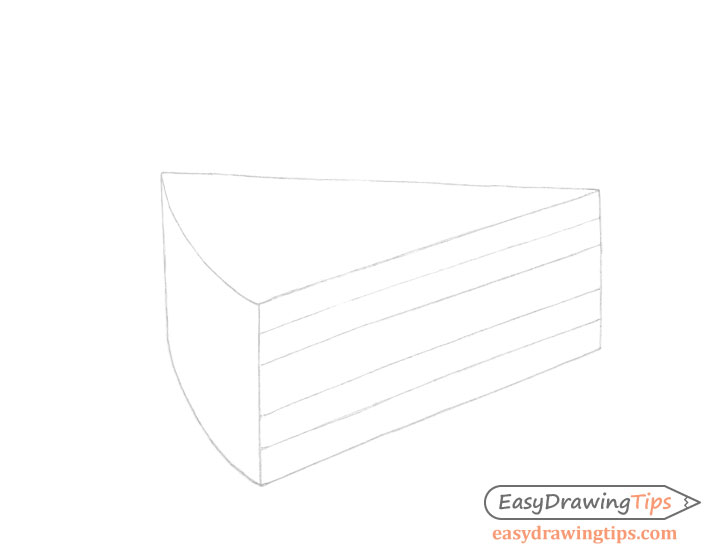
Once you have the main shape of the slice outlined, divide its front-facing side into layers. In this case, the cake features a thick layer in the middle with two thinner layers below and above it. At this stage, define these thin filling layers with just a single line each. These lines will act as your shading guides in a later step.
Step 3 – Draw the Cherry and the Frosting

Add the frosting and cherry to the top of the cake. Draw these right over the slice’s outline and erase any overlapping lines afterwards. To start, make a simplified drawing of the frosting’s overall shape without the smaller details. Think of the frosting along the edge as a flattened, slightly curved tube, and the portion below the cherry as two stacked doughnuts (a larger one on the bottom and a smaller one on top).
Draw the cherry sitting on top of the two “doughnuts” with an upward-pointing, slightly curved stem.
For more on drawing cherries, see:
How to Draw Cherries Step by Step
Step 4 – Draw the Details of the Frosting

Using the previously defined shape as a guide, draw a twist into the frosting along the edge of the slice. You can erase parts of its overall outlines as needed when doing so. Draw the twist’s various sections starting from its forward-facing end and going towards the back. Afterwards, draw a swirl along its surface as a series of curved lines.
Also, draw a swirl along the two “doughnuts” using a series of wavy lines.
Step 5 – Outline the Main Shadow Cast by the Slice

For the last step of the line drawing, outline the shadow cast by the cake slice on the surface it’s sitting on. In this case, the main light source is positioned to the upper right and slightly to the front of the cake. This means that the shadow will be cast to the left and slightly behind the slice. Also, since the light source is fairly high up, the shadow is quite short.
Step 6 – Shade the Different Sides of the Slice

With the line drawing complete, you can begin the shading process. First, establish the cake’s largest light and dark areas by shading its three main visible sides (leave the frosting and cherry for later). For this particular drawing, you can blend your strokes to the point where they are barely visible.
Something to be aware of when shading is that despite the lighting, some parts of the cake are just naturally dark. For example, the top of the slice is darker because of dark frosting along its surface. The curved back part of the slice is much darker not only because it’s facing away from the light, but also because it’s made of a darker ingredient (chocolate).
To learn more about different stroke types and shading techniques, see:
Shading Techniques and Stroke Types Drawing Tutorial
Step 7 – Shade the Layers

Shade the layers of the cake’s filling, starting with the thick, chocolate cream in the middle. Make it about as dark as the chocolate along the back of the slice. Next, using the lines from Step 2 as guides, create two thin layers of chocolate fudge. Make these slightly darker than the cream.
Step 8 – Shade the Cherry

Since the light is coming from the upper right, shade the cherry to be darker along its bottom and left side. However, it also has a middle groove, part of which catches some light, and a bright highlight on the upper right. Make these areas lighter, especially the highlight. Also, leave a lighter area around the cherry’s bottom to show the white frosting reflecting from its smooth surface.
Step 9 – Add the Shadows Cast by the Slice and Frosting

Fill in the outline of the main shadow cast by the slice. Afterwards, also add a couple of smaller shadows cast by the frosting onto the cake’s surface. Make each shadow darker at its base and lighter as it extends outwards.
Step 10 – Shade the Frosting

Finally, shade the frosting. First, shade each of its areas as a whole (ignoring the swirls). Give the twist a dark-to-light gradient extending upwards from its bottom. Do the same for the “doughnut” shapes. Also, add a darker area along their left sides that is created by the cherry’s shadow. Afterwards, shade the swirls. Do this by darkening the left sides of the little ridges.
When done with the above, you can refine your shading by further blending or darkening any areas that require it.
Conclusion
This tutorial shows how to create a realistic-looking drawing of a slice of cake (with a cherry on top). This is done by first making a clean and simple line structure and then by applying shading to it in several layers. As is mentioned in many other tutorials here on EasyDrawingTips, a good approach to drawing is to start with the largest and most important parts of an object and to gradually work down to its smaller details.
Hopefully, you’ve found this guide helpful and the steps easy to follow. For more similar tutorials, also see the following:
- How to Draw a Muffin Step by Step
- Egg Step by Step Basic Shading Tutorial
- How to Draw a Croissant Step by Step
- How to Draw a Hammer in 10 Steps